Our complex has 34 staircases that are currently constructed with pressure-treated wood. Every 10 years they need complete replacement. But after just one to two years, they already become visually unattractive because of normal wear and tear.
Rebuilding the staircases in a townhouse complex using modern composite materials offers significant long-term advantages compared with traditional pressure-treated wood. While wood has historically been the default choice, modern composites provide vastly improved durability, lower maintenance costs, and a noticeable improvement in curb appeal, along with other benefits. These are key factors for strata owners seeking to protect property values.
Below is an example of what the wooden stairs in our complex look like after a few years, vs what composite stairs would look like in the same amount of time:
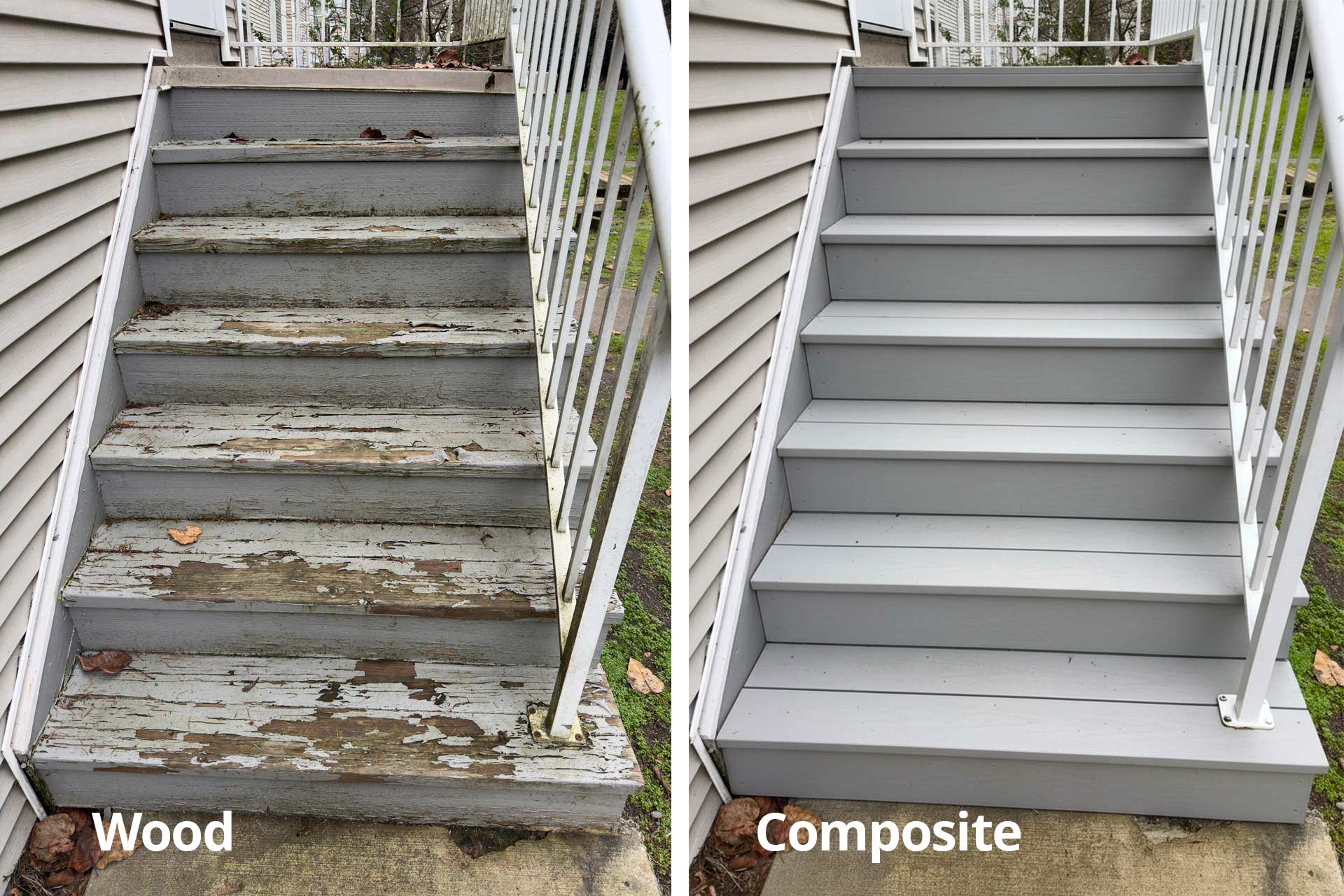
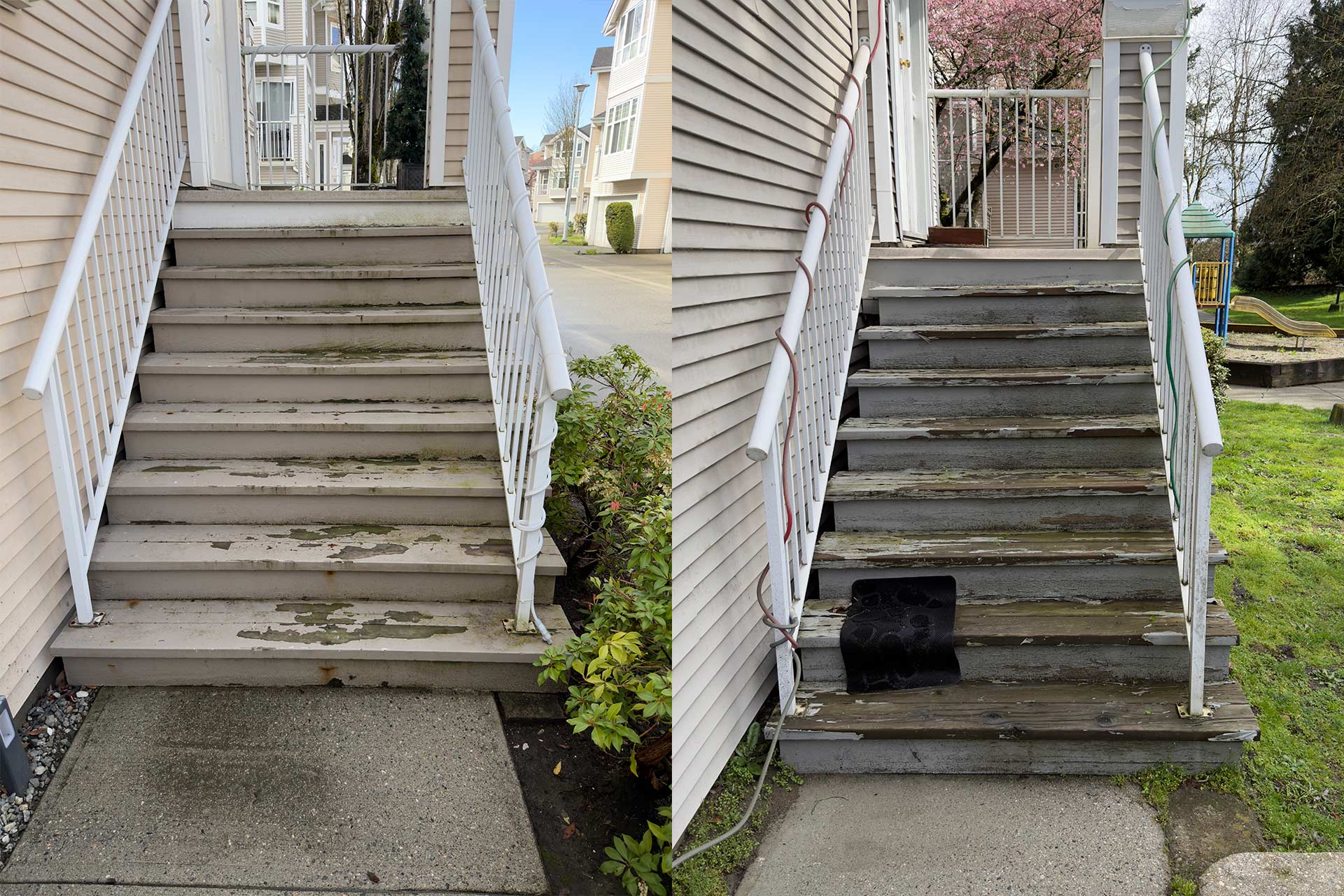
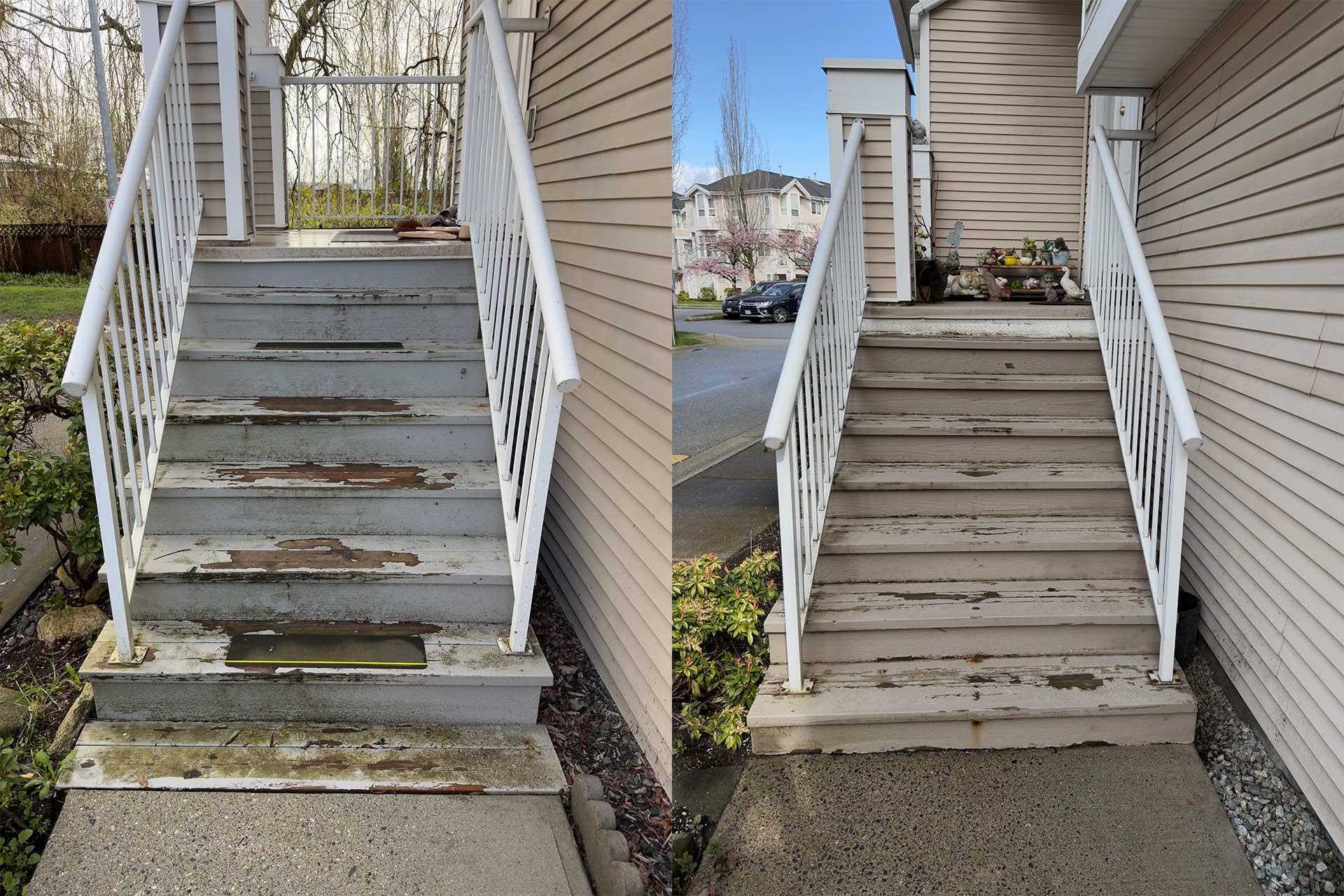
Think about the first impression that a visitor receives when initially approaching any unit in our complex that has wooden stairs. In almost every case, the paint has been badly worn. In the worst cases, very little paint remains, with nails rusted out and beginning to lift above the stair surface, creating a trip hazard. If you were a buyer, what impression would this make before you even enter the unit?
Composite materials have been around for a number of years now. They cost a bit more than wood, but the benefits they offer are considerable, and worth thinking about. Let’s take a look at how they differ from wood:
Lower Maintenance
First, composite materials dramatically reduce ongoing maintenance. Pressure-treated wood requires regular sealing, painting, and board replacement as it ages, splinters, and warps. Even after just one year, paint surfaces already start wearing off on the front edges where feet scrape the surface, exposing the raw wood underneath and starting the destructive process that eventually leads to rot.
In contrast, composite boards are engineered from recycled plastics and wood fibers that resist moisture, rot, and insect damage. This means staircases can maintain their structural integrity and appearance for decades with minimal upkeep. You can even power wash them (gently of course), something that can’t be done at all on wood stairs because it strips off the paint. Composites typically require little more than periodic cleaning rather than sanding or painting. For a strata corporation, this translates directly into lower long-term maintenance budgets and fewer repair cycles.
Better Curb Appeal
Second, composite staircases maintain a more consistent and attractive appearance. Wood stair treads quickly fade, crack, and discolor unevenly, especially in climates like ours where rain and algae growth are common. Composite materials are color-stable. They are manufactured with textured finishes that resemble natural wood but remain uniform year after year. The look can be matched almost perfectly to what our design standards call for, but they continue to hold that look for decades, while wood stairs start to look terrible after just a couple of years, and become disgusting after five years.
As a result, the use of composites helps the complex maintain a well-kept, modern look, which enhances curb appeal and supports property values when owners decide to sell.
Visually Identical
Some people think composites would cause staircases to look radically different from others. Not so. If owners wish to go this route, the complex would eventually replace all staircases with composite versions, but in the meantime the look is identical to the way the wooden stairs look when initially installed. The color and styling are the same. From just a few feet away, you would never tell the difference!
Composites are Safer
Safety is another important advantage. Composite materials are designed with slip-resistant surfaces. This is especially evident in winter. Wood, especially where paint has worn off, becomes exceptionally slippery in icy conditions. In contrast, composite stairs still offer a bit of stability when there’s ice. They don’t splinter like aging wood, either. There are no nails on the board surface that can start to release and stick up to create a trip hazard. This reduces the risk of injuries for residents and visitors and may help mitigate liability concerns for the strata.
Environmentally Friendly
Finally, composites support sustainability goals. These products, though they look like wood, are manufactured from recycled materials, reducing reliance on newly harvested lumber while delivering a longer service life. Some companies offer a 50-year warranty on the material! Compare that to wood which would need to be replaced up to five times in that same time period.
In summary, composite staircases provide a cleaner aesthetic, greater durability, improved safety, and virtually no lifetime maintenance costs. This makes them a strategic investment for any townhouse strata looking to improve curb appeal while responsibly managing long-term infrastructure expenses.
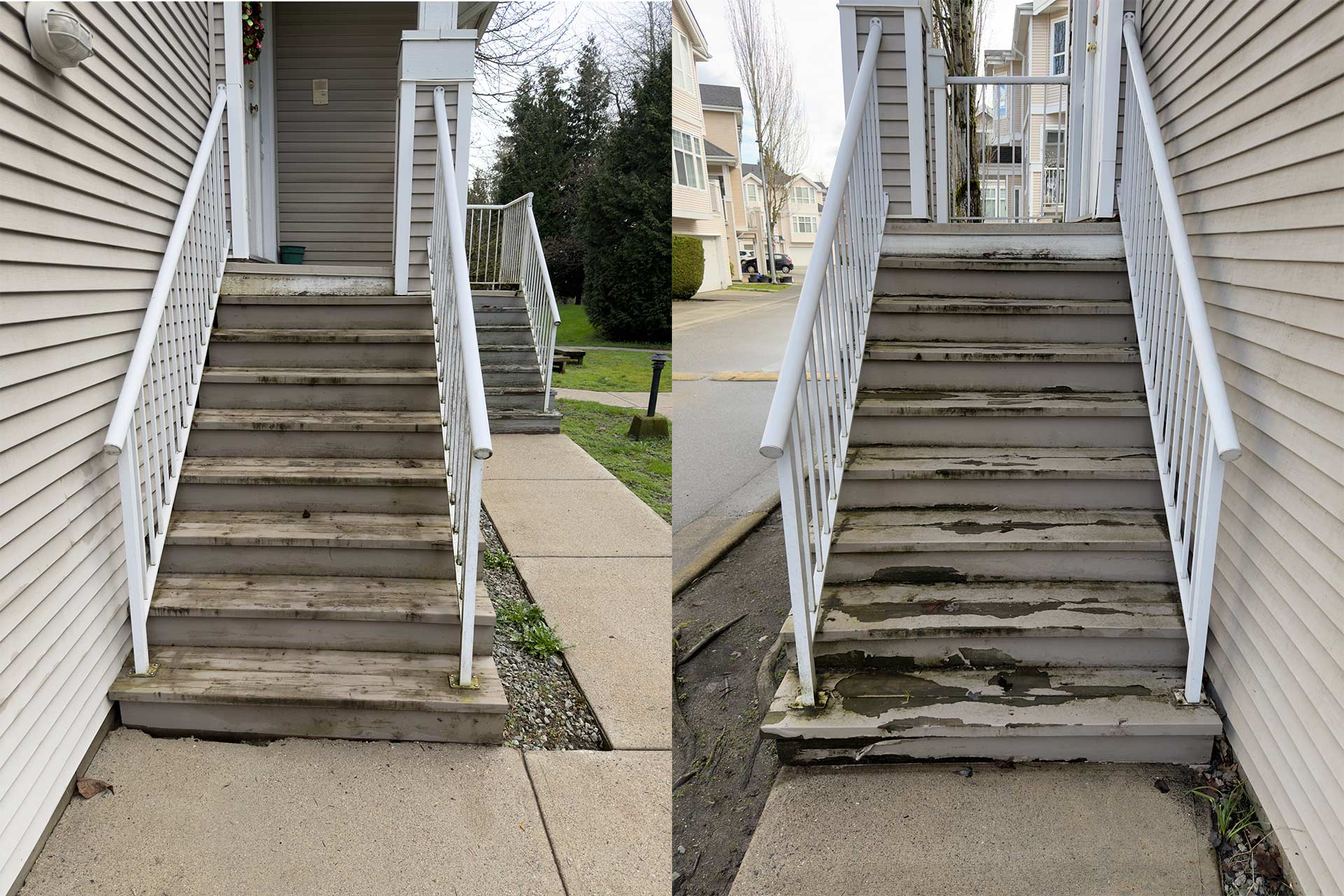
What do our stairs look like now? Most of them are not pretty. Shown below are just a few examples. If you were a potential buyer, what would this say to you as you approach the unit? If you’re an owner, how does this make you feel about your home?

Typical Lifespan Comparison
Let’s take a look at how these benefits actually apply in dollars and cents.
Construction Costs
Pressure-Treated Wood: In practice, wood stairs begin showing significant wear within 10 years, often requiring full replacement, resurfacing, or structural repairs. At an average construction cost in today’s dollars of about CAD$3,000 per staircase, that means we can expect to spend CAD$9,000 per unit on construction alone over the next 30 years. The actual amount will be higher when adding inflation. This figure doesn’t include painting and maintenance, it is merely the construction portion.
Total rebuilding cost in year 1 (per unit): approx CAD$3,000
Total rebuilding cost by year 10: approx CAD$6,000
Total rebuilding cost by year 20: approx CAD$9,000
Total rebuilding cost by year 30: approx CAD$12,000
Composite Materials: These staircases typically last 25-30 years before they need any construction refinements, and that is only because of the wood framing underneath which supports the landing and staircase. One builder has said that they would install butyl tape to protect the wood and significantly increase the lifespan of the frame. That construction cost, when required, is much lower because the boards themselves do not need replacement. Some products carry warranties up to 50 years on the material. The cost of material is higher, at about twice the cost of wood, but as the boards never need replacing, the overall cost over 30 years can be expected to be about CAD$4,800 per unit. Again, this doesn’t include painting and maintenance (neither is needed). Let’s allow CAD$1,000 for rebuilding the wooden frame in year 30.
Total rebuilding cost in year 1 (per unit): approx CAD$4,800
Total rebuilding cost by year 30: approx CAD$5,800
Maintenance Costs
Pressure-Treated Wood: Wood requires continual maintenance to slow the deterioration caused by moisture, UV exposure, mold and insects. Wood can’t be power washed as it destroys the paint. It does need to be repainted and sealed every 1-3 years. In addition, boards may need to be replaced as the wood cracks or splinters. Painting a stair currently costs CAD$325-$350 per staircase, and that cost will increase over time due to inflation. Let’s just focus on the current price. If we paint every 2 years, the total cost over 30 years for painting alone amounts to CAD$4,875 per unit. Now the total goes up substantially, amounting to roughly twice the cost of composites.
Total maintenance cost by year 10: CAD$1,625
Total maintenance cost by year 20: CAD$3,250
Total maintenance cost by year 30: CAD$4,875
Composite Materials: There are no maintenance costs. Stairs can be power washed regularly with no concerns about paint, because there is no paint. There are no boards that need replacing. Occasional washing with soap and water are ideal.
Total maintenance cost by year 10: $0
Total maintenance cost by year 30: $0
Let’s examine how that compares when you combine construction and maintenance components:
- Pressure-treated wood over 30 years: CAD$16,875
- Composite materials over 30 years: CAD$5,800
This translates into lower budgets, fewer contractor visits, and less disruption for Windsor Garden residents while preserving a consistent, high-quality appearance across the property.
Construction and Budget Timeline
Just as it would be if using pressure treated wood, we would divide the project over a number of years. There are currently 10 staircases that need immediate attention. We could do the six most urgent in year one, at a cost of about CAD$33,000. Then five more in year two. Another five in year three gets us about halfway through the entire collection. Four years from now more staircases will be ready for attention, so we would likely continue on a similar schedule, with a handful updated each year until all 34 are finished. By the time we reach the 10th year, when the stairs that were just built in 2025 are ready for a rebuild, we would be all done with no further need of stairs except for occasionally needing to work on the underlying wood framing, which would be handled as required. At that point in time, the total expenditure for construction and maintenance would equal roughly the same as using wood, but no further maintenance would be needed beyond that point to rebuild or paint the stairs. For the next 20 years we would be essentially cost free.
The Bottom Line
In short, composite materials, over time, are 50% cheaper. They shift the focus from ongoing repair and refinishing to long-term durability and stability, which is particularly valuable for shared strata infrastructure. Curb appeal is increased, raising the perceived value of our properties. Safety is improved because of the anti-slip properties of the material.
Not all the stairs need to be replaced right away. The ones in the worst condition would be dealt with immediately, if owners agree on this direction, while others would be upgraded in future years. Within 10 years all the stairs would be constructed of composite materials.